
You wake up with a nagging pain, a rash that won’t go away, or a child who keeps coughing. You know you need a doctor, but which one? Medicine specialist, cardiologist, gastroenterologist, ENT?
In Bangladesh this question is harder because there is rarely a formal referral system. Most patients choose their own specialist, and picking the wrong one can mean wasted time, extra cost and delayed treatment.
This guide helps you match common symptoms to the right kind of doctor, know when a problem can’t wait, and find specialists near you on HealthCareBD.
Important: This guide is for general information only. It is not medical advice or a diagnosis. If you are unsure or your symptoms are severe, see a qualified doctor.
First: Is This an Emergency?
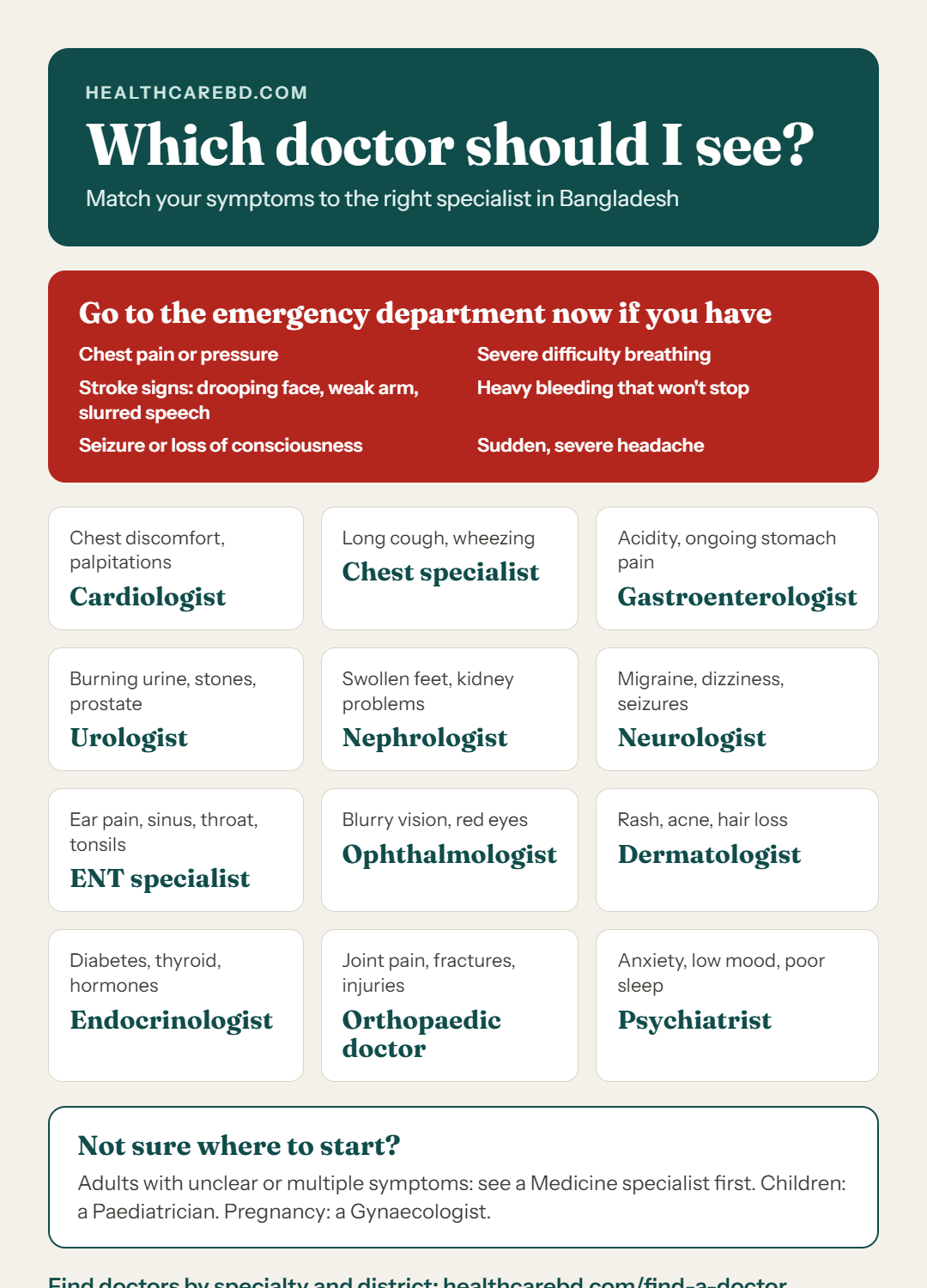
Some symptoms should never wait for a chamber appointment. Go to the nearest hospital emergency department, or call an ambulance, if you or someone else has:
- Chest pain or pressure, especially with sweating, nausea or pain spreading to the arm or jaw
- Severe difficulty breathing
- Sudden weakness or numbness on one side of the body, drooping face, slurred speech, or sudden confusion (possible stroke)
- Heavy bleeding that won’t stop, or vomiting blood
- Sudden severe headache unlike any before
- Loss of consciousness or seizure
- Severe abdominal pain
- Inability to pass urine
- A serious accident, burn or poisoning
- Thoughts of harming yourself
You can find help through our ambulance service page, and use the blood availability page if blood is needed urgently.
Not Sure Where to Start? See a Medicine Specialist First
If your symptoms are vague, involve more than one part of the body, or you don’t know what’s wrong, start with a Medicine or Internal Medicine specialist. They assess adults with a wide range of conditions and can either treat you or point you to the right specialist.
For children, start with a Paediatrician.
Symptom-to-Specialist Quick Guide
| If you have… | Consider seeing | Browse on HealthCareBD |
|---|---|---|
| Ongoing chest discomfort on exertion, palpitations, high blood pressure | Cardiologist | Cardiology |
| Long-lasting cough, wheezing, breathlessness | Chest Diseases specialist | Chest Diseases |
| Acidity, bloating, ongoing stomach pain, difficulty swallowing, changes in bowel habit | Gastroenterologist | Gastroenterology |
| Jaundice, long-standing liver problems, hepatitis | Hepatologist | Hepatology |
| Piles, anal pain or bleeding, fissures | Colorectal Surgeon | Colorectal Surgery |
| Swelling of face or feet, changes in urine, known kidney problems | Nephrologist | Nephrology |
| Burning urination, kidney or bladder stones, prostate problems | Urologist | Urology |
| Persistent or severe headache, dizziness, seizures, numbness, tremor | Neurologist (Neuro Medicine) | Neuro Medicine |
| Back or neck problems needing surgical assessment, brain or spine conditions | Neurosurgeon | Neuro Surgery |
| Ear pain, hearing problems, sinus trouble, throat pain, tonsils | ENT specialist | ENT |
| Blurry vision, red or painful eyes, eye check-ups | Ophthalmologist | Ophthalmology |
| Rash, acne, hair loss, fungal infection, itching | Dermatologist | Dermatology |
| Diabetes, thyroid problems, hormone concerns | Endocrinologist / Diabetologist | Endocrinology |
| Joint pain, fractures, sports injuries, knee or hip problems | Orthopaedic doctor | Orthopaedics |
| Swollen, stiff joints, autoimmune conditions | Rheumatologist | Rheumatology |
| Pregnancy care, irregular periods, pelvic pain | Gynaecologist / Obstetrician | Gynaecology & Obs |
| Difficulty conceiving | Gynaecologist (fertility) | Gynecology & Infertility |
| Fever, cough or growth concerns in a child | Paediatrician | Paediatrics |
| Tooth pain, bleeding gums, dental checkups | Dentist | Dentistry |
| Low mood, anxiety, sleep problems, panic, unusual thoughts | Psychiatrist | Psychiatry |
| Anaemia, easy bruising, blood disorders | Haematologist | Hematology |
| Lumps, unexplained weight loss, cancer diagnosis | Oncologist | Oncology |
| Recurring allergies, hives, allergic reactions | Allergy specialist | Allergy |
| Weight management, diet planning for a condition | Nutritionist | Nutritionist |
| Recovery after stroke, injury or surgery; chronic pain | Physical Medicine & Rehabilitation | PMR |
Common Confusions, Explained
Cardiologist vs Cardiac Surgeon. A cardiologist diagnoses and manages heart conditions with medicine and procedures. A cardiac surgeon performs operations. You usually see a cardiologist first.
Neurologist vs Neurosurgeon. Similar names, different roles. A neurologist treats conditions like migraine, epilepsy and stroke recovery without surgery. A neurosurgeon operates on the brain and spine. Start with a neurologist unless you’ve been told you need surgery.
Nephrologist vs Urologist. A nephrologist treats kidney function and kidney disease. A urologist treats the urinary tract, stones and the prostate, including surgery.
Gynaecologist vs Obstetrician. Most doctors in Bangladesh practice both, covering women’s reproductive health as well as pregnancy and childbirth.
Psychiatrist vs Psychologist. A psychiatrist is a medical doctor who can prescribe medicine. A psychologist provides talk-based therapy and cannot prescribe.
Endocrinologist vs Diabetologist. Overlapping fields. Both manage diabetes, and endocrinologists also treat thyroid, hormone and metabolic conditions.
What If You Have Several Symptoms at Once?
Many people feel tired, have joint pain and also feel breathless, and wonder whether they need three doctors. You don’t. Start with a Medicine or Internal Medicine specialist, who can look at the whole picture, order tests and refer you if needed.
If one symptom is clearly worse than the others, such as chest pain with palpitations, start with the specialist for that problem (a cardiologist here).
Special Situations
Children. Start with a pediatricians for anything from fever to feeding problems. Emergency signs in children, including difficulty breathing, unusual drowsiness, dehydration or seizures, need hospital care immediately.
Pregnancy. See a gynecologists’ or obstetrician for regular antenatal care. Bleeding, severe pain, reduced baby movement, or severe headache with swelling should be assessed urgently.
Older adults. Symptoms often overlap. A Medicine specialist is a good first stop. Bring every medicine the person is taking.
Mental health. Feeling persistently low, anxious or unable to sleep is a valid reason to see a doctor, just like a physical symptom. A psychiatrist can assess and guide treatment.
Long-term conditions. If you have diabetes, high blood pressure, asthma or kidney disease, see the same specialist regularly rather than switching each time.
How to Prepare Before You See the Doctor
A little preparation makes a short consultation far more useful.
- Write down your symptoms. When they started, how they’ve changed, and what makes them better or worse.
- List all your medicines, including herbal products and supplements.
- Carry previous reports, prescriptions and test results in one folder.
- Note important history, such as allergies, past surgeries and family conditions.
- Prepare your questions. Ask what the likely cause is, what tests are needed, and when to come back.
- Confirm chamber timing by phone or WhatsApp before travelling, especially in another district.
How to Choose the Right Doctor Once You Know the Specialty
- Check qualifications and the hospital affiliation shown on the profile.
- Look at chamber address and visiting hours to make sure they suit you.
- Consider location. For a long-term condition, a doctor you can reach easily helps you keep up follow-up visits.
- Feel free to get a second opinion for major diagnoses or planned surgery.
On HealthCareBD you can find a doctor by specialty and district, including Dhaka, Chittagong, Sylhet, Rajshahi and more.
Frequently Asked Questions
Should I see a general physician or a specialist first?
If you’re unsure what’s causing your symptoms, start with a Medicine or Internal Medicine specialist. If your problem clearly falls into one area, such as skin, eyes or teeth, go directly to that specialist.
Do I need a referral to see a specialist in Bangladesh?
In most cases no. You can book specialists directly, though a Medicine specialist can help you choose if you’re unsure.
Which doctor should I see for fever?
Start with a Medicine specialist for adults or a paediatrician for children. High fever with severe headache, stiff neck, confusion, rash, breathing difficulty or a fever that persists needs prompt medical attention.
Which doctor treats headaches?
A Medicine specialist or neurologist. Sudden, severe headache or headache with weakness, vision changes or confusion is an emergency.
Which doctor should I see for stomach pain?
A gastroenterologist or Medicine specialist. Severe or sudden abdominal pain needs emergency care.
Which doctor treats back pain?
Start with an orthopaedic doctor or a Physical Medicine specialist. See a neurologist or neurosurgeon if you have numbness, weakness or bladder problems.
Can I see two specialists for the same problem?
Yes, and it’s reasonable for a second opinion. Share your previous reports so tests aren’t repeated.
How do I find a specialist near me?
Use the HealthCareBD doctor search to filter by specialty and district.
The Bottom Line
You don’t need to diagnose yourself. You only need to find a sensible starting point. If it could be an emergency, go to the hospital. If it’s unclear, start with a Medicine specialist. If it’s clearly one body system, see that specialist directly.
When you’re ready, search doctors by specialty and district on HealthCareBD.
Disclaimer: This article is for information only and does not replace professional medical advice, diagnosis or treatment. See our full disclaimer.
Reviewed by Dr. Fatema Rahman Mun, MBBS (DU)